La manipulation mentale by Arnaud Esquerre: A Sociology of the Accusation Itself
CICNS · 1 June 2009
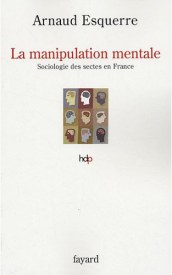
Mental Manipulation, by Arnaud Esquerre
La manipulation mentale – Sociologie des sectes en France, Éditions Fayard, 2009 (376 pages).
CICNS reading report (June 2009)
Arnaud Esquerre is a sociologist attached to the group of political and moral sociology (GSPM) at the Ecole des Hautes Etudes en Sciences Sociales, and he taught at Sciences Po Paris from 2005 to 2008.
In this work, Arnaud Esquerre approaches the contemporary question of the “cults” by analysing the accusation of mental manipulation levelled against the groups thus labelled. This accusation is, according to him, what most characterises the anti-cult combat conducted in France today, and the analysis of the notion of mental manipulation makes it possible to decipher it.
Carrying out a historical survey of the notion of “cult”, from the nineteenth century to our own day, he shows that it is not new; the words and expressions carrying the accusations against the “cults” have, on the other hand, evolved to arrive at the concept of mental manipulation.
He then presents a detailed analysis of the rhetorics relating to the notion of mental manipulation employed by the different protagonists: the people accused of being manipulated, the relatives making the accusations, the victims’ defence associations, the public authorities, the specialists of the psyche. Through real cases involving these protagonists, he illustrates the vagueness and the risks of arbitrariness linked to a notion that led to the elaboration of the About-Picard law and of a law controlling the title of psychotherapist: “What distinguishes a fabricated consent from a consent not fabricated by someone else? Who is in a position to make the distinction? What are the very signs of a mental manipulation? To all these questions, the denouncers of mental manipulation and promoters of autonomy frequently remain without an answer; they decide on the basis of narratives and without giving further explanations whether the narrator is manipulated or authentically master of his acts, or they enumerate innumerable techniques of manipulation in an untangleable jumble illustrated by examples that are most often theoretical. To denounce the loss of autonomy of a human being and to consider that he is mentally manipulated makes sense only in a local and particular way”.
The combat conducted by the State against the cults that mentally manipulate falls, according to Arnaud Esquerre, within a set of “apparatuses of power over the psyche”. These apparatuses “are more worrying than others, because they touch us still more deeply than the others. And because, more than other apparatuses of power, they leave those who have the mastery of them a greater margin of arbitrariness”.
Arnaud Esquerre’s book sheds very pertinent light on the ins and outs of the French anti-cult fight. It participates in cleaning up a particularly confused and emotional debate in which few researchers and intellectuals “dare” to approach this question of society frontally, although it is a particularly salient marker of certain forms of intolerance in our country. We warmly recommend reading it.
Extracts (the hyperlinks are added by the CICNS)
Words organise the lives of human beings. Some of them mark their era more than others. Without one noticing it at first, they circulate at an ever more sustained rhythm. When they serve as foundations for collective actions and for laws, it is already too late: these words have imposed themselves with such self-evidence that it seems difficult to us to be able to reason without them (…) “Mental manipulation” belongs to this variety of words.
(…) if the Catholic Church denounced the “cults” by considering that they were communities which interpreted the holy Scriptures badly, or which did not refer to them when they ought to have done so, the same could not be the case for the State and the victims’ associations. It is then that “mental manipulation” meets the “cult”: the latter is then considered as a totalitarian group in which a guru mentally manipulates followers.
(…) The establishment of the link between mental manipulation and the “cults” has modified other social relations. These groups were defined in relation to the religions; they are henceforth also, and almost more, attached to the therapies. Whereas the priests diagnosed a bad interpretation of the Bible or practices contrary to Catholic rites, psychologists and psychiatrists give expert assessments of mental manipulation and help those leaving a “cult” to recover their autonomy. Now, a hitherto unprecedented fact, certain “cults” are accused of developing allegedly therapeutic activities. It is thus that “mental manipulation” has drawn in its wake another word, that of “psychotherapist”.
(…) The designation of a singular social aggregate as a “cult” is always a judgement passed on it by the institutions: it is never its own way of designating itself, and it can be the object of a contradiction. For this reason, I enclose the term “cult” in quotation marks. This does not indicate that the designated groups have a certificate of innocence, because the practices of certain “cults” are criminally condemned, but it signifies that the judgement implied by the term is suspended.
(…) The history of the “cults” is first of all that of a word, marked by a strong local specificity, which some impose on others. Outside France, the history of the “cults” is written differently.
(…) The accusation of being one is never an innocuous act. The term “cult” circulates between speakers holding antagonistic positions. This circulation, historically and socially situated, is negatively charged, the “cult” designating a group whose disappearance is wished for, and the very use of the word depends on relations of force between the collective beings concerned.
(…) In the course of the 1970s, various “cults” declared “new” are identified in France. The novelty is said to reside in the fact that these particular “cults” would no longer belong to a dissidence in relation to the Catholic Church or to the other established Protestant Churches. They would be foreign to them and would require other criteria of evaluation. I shall maintain that what changes is above all the manner in which the “cults” are denounced.
(…) A gendarmerie officer who had studied psychology and sociology, Jean-Pierre Morin associates the “cults” with psychic rape (…) The latter would be international organisations whose purpose would be to dominate the world by imposing a fascist ideology (…) The writings of Roger Ikor [CICNS: founder of the CCMM] also participate in the mutation of the fight against the “cults” at the beginning of the 1980s (…) However, the new reference for conceiving the cult is totalitarianism (…) The notion for explaining the functioning of a “cult” is mental manipulation (…). Fascism and psychic rape, totalitarianism and mental manipulation: the bases are laid for organising the new fight against the “cults”.
(…) The “cult” as a totalitarian organisation, with a therapeutic, spiritual, philosophical or religious aim, and in which the followers are mentally manipulated, is a French and collective invention of the 1970s and 1980s.
(…) The French actors who fight the “cults” are conscious of the singularity of their action in relation to those that take place in other countries. They present it as an avant-garde: once again, France, the nation of human rights, would be at the forefront of new ideas, and would be ready to export and impose on the rest of the world one of its latest discoveries, the totalitarian and manipulative “cult”, which every democracy ought to fight following the French model.
(…) The term “cult” agglomerates at a stroke, by the double reference to totalitarianism and to mental manipulation, a multitude of heterogeneous groups, which may number a dozen members or several thousand, and whose practices and discourses are foreign to and without coherence with one another. The unity that the term “cult” produces has as its consequence that a single practice or a single idea of one of the “cults” suffices to condemn the whole.
(…) The very principle of the discourse against the “cults” is that they are unassimilable to society and must remain so. The “cults” do not today teach us something only about the religions. In the manner in which they are fought, the “cults” teach us more surely about what the majority of society admits and does not admit, and about what the State authorises and does not authorise.
(…) Legally, the victims’ defence association and the association with a therapeutic aim fall under one and the same law, that of 1901 on associations. A jurist unfamiliar with the complex arrangement of French society could therefore advance that they are equally recognised by the State. But that is not the case, because the State too concerns itself with fighting the “cults”. There is therefore a continuity between the victims’ defence associations and the State, whereas, from the instant when the Unadfi designates association X as a possible “cult”, the latter becomes socially illegitimate, indeed dangerous.
(…) For the follower as for the relatives who fight the “cult”, one stake is to legitimise the assertion of autonomy and the validity of the accusation of manipulation by appealing to references placed above them and supposed to be incontestable (…) the relatives in the fight against the “cult” legitimise their accusations by mobilising “official” information (…) The “official” is not limited to the legal texts that emanate from the government and the public administration; it is a set of discourses, conducts and beings approved as admissible and admitted by the State, which is credited with laying down, if not the truth, at least the general norm to which one must refer. Reference, direct or indirect, to the State has a strong effect in establishing the legitimacy of a statement. Being on the side recognised as legitimate by the State has as its result that a relative who has entered into the fight against the “cult” feels no need to call himself into question (…) Defending oneself against an accusation of manipulation leads to a paradoxical situation: autonomy (the fact of not being manipulated) has as its consequence that a human being ought to be able to justify every act, but justifying every act is an operation as exhausting as it is impossible.
(…) Each mobilises the conception of autonomy that best serves his interests and his desires. He who adheres to a “cult” appeals to an autonomy that depends only on himself. An actor defending the victims of “cults” mobilises a conception of the autonomy of the legal person, fixed by a State that denies those who adhere to a “cult” the possibility of being autonomous. But that reckons without the fact that saying “I am autonomous” retains a validity. Who recognises this validity? When a member of a “cult” says “I am autonomous”, while the actors defending the victims consider that he is manipulated, those who recognise this autonomy asserted in the first person, apart from the speaker himself, are the other persons sharing the same point of view. [CICNS: the two preceding paragraphs are drawn from an analysis following the account of a particular real situation.]
(…) Autonomy cannot be detached either from the effects created by the statements, or from the positions and social references of those who utter them. As soon as a contradiction arises between the autonomy of the legal person and that of the human being, a dispute breaks out between the holders of the autonomy guaranteed by the State and those of the autonomy asserted by the being concerned. The former make the being concerned understand that he is in the process of leaving the set of persons whose autonomy is recognised by the State, in order to join the set of non-autonomous beings, in which one finds pell-mell things, non-human animals, and a few humans whom the State considers to have lost their autonomy because they are incapable of moving, because they act in an unreasonable manner or because they are in a coma. For his part, the being concerned engages in a battle in which he is very weak, discovering with stupefaction that the assertion of his autonomy, which until then functioned so well because no contradiction had appeared, does not impose itself against the force of the State and of those who lay claim to it.
(…) Roger Ikor defends a model of the family that is currently obsolete, in which the father directs the children in an authoritarian manner. This conception is the foundation of the fight against the “cults”. Such a model is moreover perhaps only provisionally obsolete, because, in the 2000s, some say they are nostalgic for it and politicians are attempting to rehabilitate it by updating it, the authoritarian direction being no longer entrusted only to the father, but to the parents, whatever their sex.
Now, to defend the family does not necessarily mean defending an authoritarian and biological model of the family. And a fight against certain “cults” can be legitimised otherwise than by this model organised by authority and rank.
One would speak today of parental responsibility rather than of parental authority. And the term “parental” itself no longer refers to the sole relation of biological engendering: adopted children, children of a partner’s first marriage, et cetera, also figure in present-day families, under the responsibility of “parents” who are no longer necessarily “natural”. The family can be founded on will, as Marcela Iacub proposes, for whom “all children would find the same foundation for the establishment of the bonds of filiation: the will of some — indeed of a single person — to be their parents” (Iacub Marcela, L’Empire du ventre, Paris, Fayard, 2004, p.349). Hence this question: would the entry of a being into a “cult” not gain from being thought on the model of other human choices, such as that of adhering to an elective community, defined by a life project and by will, and not by the ties of blood or by authority guaranteed by the law?
(…) From what signs does a human being judge that another is mentally manipulated? (…) Succeeding in this accusation requires the accuser to mobilise at least three elements: 1) A change in the behaviours and repetitive statements of the human being considered as manipulated; 2) Behaviours and statements judged abnormal in relation to a majority way of life on the territory where they are carried out; 3) The reference by the being considered as manipulated to a third party designated as the manipulator, closer to the manipulated than to the accuser.
(…) From then on, one could consider that, in order to escape the accusation of manipulation, a group must prevent these three elements from being identified among its members (…) However, if one accepts that someone detects an evident sign of mental manipulation in acts such as looking and smiling in a certain manner, then it is difficult to escape an accusation of manipulation, because distinguishing an authentic look and smile from a manipulated look and smile belongs to an arbitrary judgement that could apply to anybody endowed with a face with lips. [CICNS: paragraph drawn from an analysis following the account of a particular real situation.]
(…) The same statement and the same behaviour, which can be solid pillars of an accusation of mental manipulation in France, are no more than sand in another way of life, and the accusation falls at the same stroke (…) Boiling a bullock’s heart representing an absent sorcerer and sticking a thousand pins into it is a combat waged by an unwitcher, a combat to which the peasants of the bocage region of north-western France have recourse, but a practice rejected by city dwellers (Favret-Saada Jeanne, Les mots, la Mort, les Sorts. La sorcellerie dans le Bocage, Paris, Gallimard, 1977).
(…) Three motives seem to me capable of being put forward to understand why a human being does not adhere to a “cult”: the attachment to the image a being has of himself and that he thinks others have of him; the social cost of adhering to a “cult”; and finally the adherence itself of a being to discourses and practices (…) I have chosen to put forward factors that appear to me important for explaining a being’s adherence or non-adherence to a “cult”, even if they are not sufficient and even if each trajectory conceals its irreducible part of singularity.
(…) This ideal vision of a society where people would be free to choose their spiritual practice and the community that pleases them does not withstand an analysis identifying the difficulties encountered by the human beings who would wish to adhere to a community classified as a “cult”. The impossibility of adhering to discourses, the attachment to the image an individual has of himself and the social cost of adhering to a “cult” are so many elements that hold the population as a whole back from adhering to a “cult”, but are also obstacles to be crossed by a person who might try to exercise her choice in order to join a spiritual community classified as a “cult”. Contrary to what is advanced by those who imply that henceforth everyone would be free to choose and to practise the spirituality he wants, the possibility of choosing a spiritual community in France is very limited and strongly controlled by the State and by a set of apparatuses. To go beyond these limits implies taking the risk of breaking one’s attachments with those close to one and of being the object of discrimination, notably in working relations.
(…) I shall study how a law, which sought to answer a problem posed in an unprecedented manner by a legal innovation, can remain without effect on the problem targeted and have unexpected effects elsewhere. It is the law of 12 June 2001, called the About-Picard law (…)
(…) The principal concern of the collective entities is to resolve the problem through law in such a way that the promulgation of the law makes it disappear. Faced with the “cults”, the offence of mental manipulation, which would make it possible to sanction criminally all those who engage in such doings, appears as the miraculous solution.
(…) The parliamentarians progressively elaborated a text on the basis of mental manipulation, evolving from the word “dependence” to that of “subjection” (…)
(…) Subjection is the state of one who is not free to act because he must undergo a constraint. It is truly, still more than dependence, a relation of power: “that which is subjected”. Subjection is not employed in criminal law; the term is used rather by historians, specialists of constitutional law and philosophers of law. How is this subjection conceived? It is psychological or physical. The “or” does not fail to astonish by the relation of equivalence it institutes. For, if physical constraint is easily identifiable, how does one determine a psychological constraint? Who can say whether there really exists or not a constraint by a psychic bond, which would impose the submission of one human being to another?
From mental manipulation to psychological subjection, there is a continuity; one finds in the background a certain conception of the will and of the “active and passive” couple. One must recall the primary definition of manipulation, its chemical and pharmaceutical sense, which comprises only one actor, the manipulator, and an object that one manipulates (a test tube, for example). Mental manipulation stages two human beings in a relation where one of the two is closer to the object than the other, the manipulator manipulating an individual as he manipulates a test tube. Mental manipulation, like psychological subjection, as they have been put in place by the parliamentarians, are founded on a couple composed of an active and a passive, which drags behind it the shadows of the subject of sexual activity (adult and free man) and of the partner-object (woman, boy, slave).
Now, the manipulated, the psychologically subjected, are “passive”: in a discourse invented by the one who designates himself as active, or by the one who, “passive”, casts the responsibility onto the other. It is a question, in the one who is manipulated, of an absence or a weakness of the will.
(…) The subjection in the law that was voted must be the result of the exercise of grave or repeated pressures or of techniques apt to alter judgement. How does one estimate the gravity of a pressure; what is the scale of gravity? In the bill adopted at first reading, the text mentioned “grave and repeated pressures”. Whereas previously account was taken of the fact that the pressure had to be grave and repeated in order to present a threat, henceforth the fact that it be either grave or repeated suffices. The very fact of repeating a pressure, whatever it may be, is henceforth suspect.
(…) It is the legal person that serves as the support for being able to say that X is indeed, even manipulated, the same X whom we know (…) What is the point of view of this being X? Mental manipulation can exist only if one considers that a human being has changed. Is the latter’s state before the manipulation not the same as that afterwards; am I not dealing with one and the same human being? What has become of the human being from before the manipulation? Or is it a matter of two different human beings?
(…) The parliamentarians had the will to condemn a particular practice, which they attached to the “cults”, their objective being to forbid the latter, but they did something quite other than merely concerning themselves with the “cults”: they created a state of psychological subjection.
For this psychological subjection, like mental manipulation, to function, one must dispense with the definition of human liberty. The use of the terms “mental” and “psychological” in fact entails an elision of liberty: their character is such that it can allow an arbitrary power to be exercised. For the proof of the existence of the psychological element does not exist; the existence of this element depends on the arbitrariness of the judges who will apply article 223-15-2 of the Penal Code.
(…) A person in a state of psychological subjection is a person the causality of whose acts is considered as coming from another person. What is at the heart of article 223-12-5 of the Penal Code is the recognition or not of a certain type of causality recognised by the State. The introduction of psychological subjection poses the question of knowing what the liberty of a subject is: a “free” subject is one who has the right submissions, submissions recognised by the State, from the point of view of one for whom the State is legitimate. From another point of view, which considers that the State deprives of liberty, the free being is the one without a State.
(…) The law is however too little applied to change the arrangements and the behaviours of persons. If the law were applied to all the situations corresponding to the article of the Penal Code on the fraudulent abuse of a state of ignorance or of weakness, then hundreds of groups would doubtless be convicted. The Head of the central bureau of religions at the Ministry of the Interior has integrated this difficulty and expresses it in these terms: “If I begin to say that judicial proceedings must be launched against all those suspected of exercising a mental hold over others, I think we are going to end up having worries” (The author’s interview with the Head of the central bureau of religions at the Ministry of the Interior, 2007).
(…) No request for the dissolution of a grouping has been made on the basis of the About-Picard law, the head of the bureau of religions observes.
(…) The head of the central bureau of religions conveys the ministry’s powerlessness where the surveillance of the “cults” is concerned. He has not yet understood, he explains, what had to be controlled: “One can control. In any case, this ministry likes control, by nature. If it is told that it does not control enough, it will control more. But one still has to try to determine what must be controlled. What must be controlled? The Republic guarantees the free exercise of worship and moreover worship must be public. I do not know what must be controlled. We are looking! One must look! The argument of all these people is to say: ‘If you do not find, it is because you are not looking. If you looked, you would find!’ That is what they tell you. In all the regions of France, there are officials of the Renseignements Généraux who are specialised in the cults, who produce blank notes… Blank notes that always tell the same things…” (The author’s interview with the Head of the central bureau of religions at the Ministry of the Interior, 2007).
(…) The head of the central bureau of religions claims the defence of public liberties and asserts that the “cults” pose no problem of public order, arguing for example that not celebrating Christmas does not disturb public order, that human beings do indeed have the right to believe what they want and to break with their family, and that mental manipulation is a concept without pertinence. Inscribing the followers of “cults” in a broader category, which is not that of victims but of missing persons, he recalls that in France thousands of people separate themselves every year from their family and their milieu and that they are entitled to do so. When the police find them at the families’ request, and observe that they are not in a particular situation of dangerousness, they must ask them whether they want their address to be communicated to their family, whether they are in France or abroad; if they refuse, that refusal is final. For the partisans of the fight against the “cults”, and to take up the expression of one of them, a former parliamentarian, the central bureau of religions would be the “good conscience” of the Ministry of the Interior.
(…) What do the articles introducing the notion of psychological subjection into the Penal Code and instituting the registration of psychotherapists say, if one links them together? They testify to the increased hold of the State over the psyche and participate in it. The State arrangement is characterised first of all by the formation of a group of specialists educated, recognised and controlled by the State: hence the fact that those holding a doctorate in medicine and those who have a title of psychologist obtained in a university framework are favoured. The State was unable to avoid taking into account the psychoanalysts regularly registered in the directories of their associations, but achieving this required the mobilisation of psychoanalysts and of a great number of people sensitive to their cause.
It is in the name of the general interest, of public health and of the fight against a scourge, the “cults”, that parliamentarians laid down the registration of psychotherapists: it was necessary to guarantee to the French their seriousness and, in an underlying way, their effectiveness. However, if professionals were designated, it would not be only the French individually who would call on them, but also the State. The latter could find there a body of experts complementary to the psychiatrists and psychologists for diagnosing the mental health of its subjects.
(…) Few experts were cited by the parliamentarians when they debated in 2004 the regulation of the title of psychotherapist. In the framework of the bill relating to public health policy, it is all the more remarkable that the words of a single expert were used by the parliamentarians as arguments in both chambers [Elisabeth Roudinesco].
(…) the historian [Elisabeth Roudinesco] places all the groups designated as “cults” on one and the same plane, so much so that a characteristic proper to one group is attributed to all the others. The juxtaposition of declarations by Moon, by Raël and by Ron Hubbard is supposed to reveal the cultic structure: a hatred of democracy, a rejection of science and of medicine, a belief in immortality, a cult of inegalitarianism, an obsession with biological purity, a eugenicist programme, an annihilation of consciousness, a destruction of identity and transgressive and perverse sexual practices. It results that “the spectre of the cultic mechanism haunts the future of democratic societies” (Roudinesco Elisabeth, Le patient, le Thérapeute et l’Etat, Paris, Fayard, 2004).
(…) Consent constitutes the most important value and the keystone of the discursive edifice of Jean-Marie Abgrall and Tobie Nathan [CICNS: two professionals of the psyche]: it is in the name of the power to consent of every human being that they build their construction (…) At the same time, this consent could be completely invalid: it would not have been willed by a human being, but someone else would have fabricated it, by mental manipulation according to Jean-Marie Abgrall, by soul-abduction according to Tobie Nathan (…)
(…) The theory of fabricated consent, whether it takes the form of mental manipulation or of soul-abduction, poses the question of knowing whether the discourses and practices inside a “cult” are such that its members lose their capacity to think for themselves and to be responsible for their acts. It is not a matter of considering that this set of discourses and practices has no impact, but I shall maintain the hypothesis that they do not have a sufficient impact for one to consider that they remove from beings the liberty to think for themselves.
In France, the “cults” aggregate what is to be rejected. Beyond the fact that they are designated by those who fight them as inauthentic — false therapy, false family, false religion — they are said to be antisocial. But what is it to be antisocial? For some, it is to belong to totalitarianism; for others, like Jean-Marie Abgrall, it is to consume drugs; for Tobie Nathan, it is to engage in sorcery. Totalitarianism, terrorism, drug addiction, sorcery are the principal references to which the “cults” are assimilated. Each time it is a matter of models of struggle already organised. The “cults” are a social object whose expulsion outside “society” is demanded and with which other objects to be expelled are associated. They contribute, in return, to giving a feeling of coherence to that “society”.
(…) One can only observe that there exists in France an unequal tolerance towards the discourses, practices and behaviours proper to communities, and that intolerance is particularly well organised. Faced with the theory of globalisation, which would uniformise our ways of life and of thought and disarticulate local cultures, a certain French culture is of a great resistance, as much against foreign cultures as against popular cultures.
(…) [For] the question of the “cults” brings with it at least two important problems. The first is the free circulation of the human beings who live in closed communities, and in particular of those who, like the children born there, have not chosen to shut themselves up in them. Frequenting certain communities, open or closed, can moreover lead certain human beings into financial situations that are unbearable to them.
In every case, the reference to totalitarianism is not adapted. France presents itself as a state governed by law, where power is limited by the recognition of popular sovereignty and of individual liberties. In this State, no community is a totalitarianism, nor is any company, nor any administration. (…)
(…) Intolerance contributes to human beings living in what I have called different “worlds”. These worlds are organised, but chance has its place in them. If they correspond to real worlds and not to possible worlds, they may contain incoherences. There exist no coherent “worlds” of which anyone could give the description. One must therefore not conceive the “worlds” in too rigid a manner, but rather as a convenience of language that I use. To put it another way again, a world is constituted by a set of bearings which may be statements, chains of thought, touches, smells, images and tastes as much as behaviours. This could also correspond to the sense of the word “world” in expressions such as “he is in his own world” or “they are not from the same world”.
To come into contact with a world other than the one in which one is used to living provokes a disturbance, of a greater or lesser intensity. This disturbance depends on the will and the capacity of each to accept or not to let his bearings be modified in contact with new beings, new manners of thought and new practices. The experience of disturbance is not exclusive to coming into contact with a “cult”. It is that of anybody encountering another world, whether traveller or therapist, ethnologist or ethologist. For then, writes Favret-Saada, “the other conducts a game whose rules one does not know; it is enough to be malleable” (Favret-Saada Jeanne, “glissements de terrains”, in Vacarme, interview conducted by Arnaud Esquerre, Emmanuelle Gallienne, Fabien Jobard, Aude Lalande and Sacha Zilberfarb, no. 28, summer 2004). Each time what is at stake is the idea that bearings are a relative and “soft” thing, that other mental worlds are possible and viable, and that one accepts to make a certain journey towards them. This journey is not a simple exchange of “worlds”. It is partially marked out by the prior conditions of the experience. But these markers do not prevent there being a risk-taking in the decision to undertake the journey, as in the decision to maintain oneself in it.
(…) The fact that, on both sides, each considers that his world is incompatible with that of the other is a source of great tension and suffering. The relation is however always unequal, because, if the human beings belonging to communities are protected by individual liberties, the others have on their side the force of the State’s services and of the actors committed to protecting a majority vision of the world.
So a less costly and happier life choice may be to hold different worlds together. Doubtless such an existence does not answer requirements of coherence that some prescribe. But is a completely coherent life so desirable an ideal?
Sources
- La manipulation mentale, par Arnaud Esquerre (archived copy of https://cicns.net/Manipulation_Mentale_Esquerre.htm)
English translation of La manipulation mentale, par Arnaud Esquerre (French), originally by CICNS.
This page reproduces third-party material (press agency reports and/or press articles). The rights to that material remain with their respective publishers; reproducing it here does not constitute a claim of ownership or licence.