Individus et pouvoirs face aux sectes: Nathalie Luca on Why the Threatening Movements Change from Country to Country
CICNS
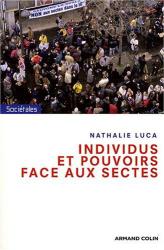
Individus et pouvoirs face aux sectes, by Nathalie Luca
Nathalie Luca is an anthropologist, a researcher at the Centre d’Etudes interdisciplinaires des Faits Religieux (CNRS/EHESS), and teaches at the EHESS. She was a member of the steering council of the interministerial mission for the fight against the cults (MILS), then of the mission of vigilance and of the fight against dérives sectaires (MIVILUDES), from which she finally resigned at the end of 2005.
In her book “Individus et pouvoirs face aux sectes”, éditions Armand Colin, Nathalie Luca proposes a new understanding of the fear that the “cults” inspire in our societies: ”(…) If one must not deny the dangerousness of certain groups, still less can one keep silent about a striking and somewhat disturbing observation: on one and the same synchronic scale, the movements that worry the public authorities change from one country to another”. ”(…) I came to wonder whether these forms of religious expression considered unacceptable, which are nicknamed “cults”, did not have as their principal defect that of jostling a little too ostensibly certain national symbolic frontiers (…) Might the State react in part because it fears that these organisations, by thus overflowing the space left to the religions, may develop in rupture with the citizens’ pact that it has a duty to defend? (…) The cults question the State’s capacity to bear that adherence to a religious community, whatever it may be, can mortgage belonging to the citizens’ community, lead the convert to deny the need he has of it, to consider it optional, or to call into question its usefulness and its protective role”. Nathalie Luca pursues her demonstration by defining “ideal-typical” models of citizens’ communities and by characterising the different reactions of the corresponding States in the face of movements regarded as “cults”. Her reflections are illustrated by concrete examples: France, Great Britain, Germany, the countries of the East, Russia, the United States, Japan, Korea, China, Brazil, Africa. The sociologist also applies herself to describing the conditions that allow a religious group to become transnational.
This necessary work on the so-called cult phenomenon makes it possible better to understand the French situation, by putting it into perspective in a globalised context. We warmly recommend reading it to anyone who wishes to get out of the knee-jerk clichés that generally accompany the evocation of the theme of the cults in France.
It is useful to recall that Nathalie Luca forms part of the too restricted number of French sociologists who “dare” to approach the theme of the cults frontally and assiduously. Most of them have moreover been interviewed by the CICNS. The difficulties encountered by French academics in studying this subject of society are a good indicator of the climate that reigns in our country. Nathalie Luca herself specifies in the work referred to: ”(…) it must be recognised that to suspect a sociologist of religions of being Catholic, Jewish, Protestant or Muslim may possibly harm the appreciation of his scientific work but is not insulting. To suspect him of being a member of a cult, on the other hand, is particularly uncomfortable. Politicians and associative militants have understood this well: as soon as a researcher in the social sciences pokes his nose into these affairs, he is told that he is one of them! From then on, what credibility remains to him?”
We propose below other extracts from Nathalie Luca’s book, followed by a certain number of commentaries that the reading of her book inspired in us (these commentaries do not necessarily concern reflections specifically addressed by Nathalie Luca; they will be limited to the case of France, which we know).
Extracts from “Individus et pouvoirs face aux sectes”, éditions Armand Colin, Nathalie Luca
”(…) To study the evolution of the relations between the State and the cults is thus to stage a whole combination of tensions declined between the citizen, free to answer the new religious offers; the transnational religious movement, more or less inclined to negotiation with the national bodies; civil society or the family; and finally the State, anxious to preserve a certain grip on culture, including religious culture, as well as a minimum of control over the citizen, globalisation making this double task more and more delicate.”
”(…) When the State comes to treat a group as a cult, it is because the latter has entered into conflict with the values of the citizens’ community of which it is the guarantor.”
”(…) Certain European countries have nevertheless ended up absorbing these movements, or at the very least have managed them peacefully enough to take them out of the category ‘cult’. Others, on the contrary, of which France is the emblem, have felt literally assailed by them, to the point of declaring war on them.”
”(…) The retotalising and desecularising dimension of these movements gives rise to the fear that their adherents may no longer be able to benefit from the liberty that the differentiation of the institutions precisely authorised.”
”(…) the list of the Gest and Guyard report, although without legal value, becomes, for the decision-makers obliged to decide, an unavoidable working instrument, liable to lead to discriminatory decisions (…) The list of 173 ‘potentially dangerous’ groups established by the parliamentary report of 1996 can also be read as answering the French State’s duty to protect ‘freedom of thought’ against everything that seems harmful to the good development of reason and of the critical spirit.”
”(…) The European Parliament thus underlines the ‘contradiction between the protection of the perfectly legitimate right to believe, and the equally legitimate right to harbour concerns as to the consequences of beliefs’*.”
”(…) The report of the commission of enquiry of the Federal Parliament (…) opposes the publication of a list of the groups active in the Federal Republic of Germany, ‘because such a list carries the considerable risk that the groups mentioned be stigmatised’**. The analysis tends finally to show that it ‘is not reasonable to describe a given group as globally radical or dangerous’. No more than one can consider the followers as simple ‘passive victims’.”
”(…) Great Britain does not seek to fight against the religious movements that are in conflict with society. It does, on the other hand, require them to conduct their contestatory activities within the legal framework (…) The implementation of such a treatment of the problems linked to the new religious movements owes much to the rigour of an association that has fought in favour of a detached treatment of the questions linked to the cults: INFORM: Information Network Focus on Religious Movements.”
”(…) Great Britain refuses both the elaboration of a negatively discriminating list, in the image of that of the [French] parliamentary report of 1996, and the systematic examination of religious communities (…) Great Britain does not neglect the questions relating to dérives sectaires or to religious practices it deems unacceptable. It concerns itself with them case by case.”
”(…) a group of a religious nature well integrated here can be stigmatised elsewhere, each country, each culture, each people not feeling equally threatened. The groups do not necessarily change from one country to another, but the threat they represent differs. It varies according to the points of vulnerability of the society.”
”(…) rights and duties vary according to the modalities of construction of the symbolic frontiers of the citizens’ community. Three ideal-typical positions make it possible to frame the possible variations: the republican position, the multicultural position and the cultural position.”
”(…) In order to develop, the religious movements play on the porosity, the credibility, the solidity or again the flexibility of these frontiers. They do not all have the vocation to spread beyond the national territory. Many, however, aspire to internationalise themselves.”
”(…) The new religious movements are not powerful enough to travel alone. So they borrow transnational currents in order to spread. In exchange, they form part of the networks of transmission of the values conveyed there.”
”(…) The degree of alert of a State faced with the cults makes it possible to decode the level of vulnerability of a nation with regard to certain forms of religious expression. In their face-to-face with societies, the spotlight has been, most of the time, trained on the said cults to the point of making one forget the actor who considered them as such. This forgetting is most often politically intended: it makes it possible to make people believe that the cults exist in the absolute. The Gest and Guyard parliamentary report of 1996, the paroxysmal moment of France’s going on alert, is a salient example of it. It had thought it opportune to posit ten criteria making it possible to interrogate the dangerousness of a cultic movement in its absoluteness. Without wishing to deny the pertinence of criteria that could apply to many other types of associations than those called into question by the parliamentarians, and without denying the existence of drifts or the despair of the victims, the case studies treated in this essay nevertheless demonstrate that the political feeling of the dangerousness of certain forms of expression — which go well beyond the sole framework of the cults or of the new religious movements — also varies according to the logics of construction of the symbolic frontiers and of the stability of the society.”
”(…) Voluntarily or not, E. Mignon [CICNS: the former head of cabinet to Nicolas Sarkozy who said “In France, the cults are a non-problem”] in any case managed to shift the lines: suddenly the media became conscious that in this debate, it was difficult for them to sidestep the definitions: what is to be understood by cult? What is to be understood by religion? The interest of the French demonstrated, if there were still need of it, that adherence to the nation also rests on the choice of spiritual conducts that integrate a certain number of implicitly shared values, and that in the end, what is reproached to the cults is that they introduce disorder and confusion into all that — all things moreover not condemnable by the law and entering into contradiction with the principle of neutrality inscribed at the heart of laïcité.”
“The words of the head of cabinet were so anxiety-inducing for French society that they had the contrary effect to the one that Western Europe could expect of them. In April 2008, the Accoyer bill aiming to give the witnesses of parliamentary commissions of enquiry the same protection as that enjoyed by persons called to testify before the courts was voted through (…) Certainly the witnesses were regularly prosecuted for defamation by the said cults. The claimants nevertheless lost their cases as soon as the witness brought proof of his good faith. He was therefore only troubled when the complainant could demonstrate that it was a matter of a highly defamatory false testimony. One may wonder about the concrete consequences of such a law, explicitly voted so that the ‘victims’ called to testify against the cults they have left should not have to answer for their words before justice. In parliamentary commissions, there is neither defence counsel, nor judge, nor jurors, nor accused. No contradictory debate is ensured. Conceived today to fight the cults, against whom will such a law be able to serve tomorrow? The state of alert has perhaps never reached such a level. Might it be because the President of the Republic, Nicolas Sarkozy, has proposed a more open laïcité, thus opening Pandora’s box?”
* Sitting document of the European Parliament: 1-47/84, 2 April 1984
** German report 1998
CICNS commentary – March 2009
The dangerousness of the “cults”
One of the merits of Nathalie Luca’s book is to propose a notion of dangerousness based not on the evocation of real or supposed offences that would be committed within the “cults”, but rather relying on a conflict of symbolic values with a nation State.
This analysis appears to us entirely pertinent. It nonetheless remains that the evocation of offences committed within the cults is always topical and feeds the rumour machine. These rumours express themselves in terms of fiscal or economic offences, of paedophilia, of ill-treatment of children and sexual abuse, of abuse of trust and of weakness, etc. It will indeed one day be necessary to treat “officially” the question of delinquency within the spiritual minorities by comparing it with that of society in general and to rule, in the light of the law, whether or not these groups are particular hotbeds of criminally sanctioned drifts. We think not, and we even believe that these groups are for the most part places where delinquency diminishes; the visible legal data and our own enquiries go in this direction (read our position on the victims of abuse within the spiritual minorities).
The deliberate absence of an answer to this question, when the cult problematic has occupied the front of the stage for three decades, allows the public authorities to perpetrate acts of discrimination without having to confront their statements with reality. Georges Fenech, the current president of the MIVILUDES, regularly and without apparent deontological problems gives media coverage to grotesque figures that have no foundation other than that of causing fear (here and there).
It is probable that certain political leaders are more or less conscious that the question is not on the point of delinquency but rather where Nathalie Luca points her finger.
The About-Picard law appears to us moreover as a regrettable will to translate this conflict of “values” into criminal law. The offence of mental manipulation at the origin of this law thus makes it possible to reject wholesale those who promote practices considered disturbing, since they become de facto “manipulators”. Nathalie Luca specifies: ”(…) It matters little what discrepancy the sociologist or the anthropologist denounces between the concrete and daily mode of functioning of society and the perception it has of itself, or again between the ethnographic description of the denounced group and the fantasy image given of it. It is in part in the register of representation that the combat is played out. In this extreme situation, the combatants deny the free and enlightened judgement of the adherent or the convert. He is assimilated to a prisoner whom it is urgent to deliver. Entry into the “cult” is interpreted as an authoritarian mode of subjection of the individual to values and rules of life that lead him to transgress those to which he is subjected by his birth.”
The parliamentarians therefore agreed to vote through a discriminatory law, permitting the dissolution of the associations of the targeted groups, without concerning themselves with the absence of scientific foundation of the concept of mental manipulation, skilfully rebaptised “psychological subjection” in the law so as not to innovate too much in the Penal Code and thus to avoid embarrassing controversies. Thanks to this law, the public authorities can once again pose the question of the cults in terms of offences (the MIVILUDES is feverishly seeking to create a case law with the About-Picard law) while remaining hypocritically in conformity with the rules of a state governed by law. The reader may refer to Patrice Rolland’s article (CNRS-EPHE) for an analysis of the genesis of the law and to Maître Pérollier’s article for an analysis of the text of the law.
The republican values of France
Nathalie Luca analyses the “republican” model type, to which France corresponds, and observes that the new religious movements “call its foundations into question by annihilating the individual-citizen to the profit of the community of adherence”.
It is entirely natural that a society should question itself about the currents that can modify, indeed endanger, its foundations. But two points are to be analysed closely: the way in which the questions are posed and the methods employed to answer them. Where the new religious movements are concerned, the good question would have been: what can or must their place be in France? And not the question of dérives sectaires, which is reductive and deliberately negative. France is doubtless the democratic country where the anti-cult terminology is the most pejorative. We have illustrated elsewhere how this devaluing language extends to every sector of society. It is hardly conceivable to construct a healthy public debate about groups and people designated by terms that are henceforth insulting.
Then the answer brought by France to this badly posed question, in the form of the fight against dérives sectaires, tramples underfoot a good number of the values that are supposed to be defended. Do amalgams, rumours, media lynchings and lists of proscriptions form part of the methods one wishes to institutionalise? There is such a contradiction between the stated intentions (respect for laïcité, freedom of conscience, etc.) and the anti-cult policy chosen by the public authorities that one can only wonder about the legitimacy of their action. Nathalie Luca illustrates well the disapproval of the countries of Western Europe and of the United States with regard to the French approach and, on the contrary, the cooperation that has taken place between France and the countries of the East (notably Russia) and China, that is to say countries that regularly infringe human rights (France, moreover, is not well placed in matters of respect for human rights on the European scale).
The sociologist writes: “The list of 173 ‘potentially dangerous’ groups established by the parliamentary report of 1996 can also be read as answering the French State’s duty to protect ‘freedom of thought’ against everything that seems harmful to the good development of reason and of the critical spirit”. It is possible, certainly, with a considerable effort of imagination, to envisage that this initial objective played a role among the parliamentarians who worked in the parliamentary commission (we can at least suppose that some were sincere in their intentions). But the result is there: the work of these parliamentarians was conducted in conditions unworthy of a democratic country, normally respectful of the adversarial principle, and freedom of thought has been seriously dented by the diffusion of such a report.
In the same order of ideas, the increasingly frequent interventions of the ADFI and of the CCMM in schools to sensitise pupils and to “develop” their critical spirit on the question of the cults are worrying. If a more balanced information is not offered to the young, freedom of thought has a dark future before it.
Must the level of alert then be high, as Nathalie Luca mentions? “The state of alert has perhaps never reached such a level”. Yet only an unreasoning fear seems to serve as the ferment of a hardening of the anti-cult fight.
The members of the spiritual minorities are citizens
Nathalie Luca speaks of a declaration of war by France on the new religious movements; the term seems to us exact and deserves reflection. Usually one does not declare war on one’s own citizens, unless one does not consider them as citizens. Does this attitude make sense, and does it not have the effect of turning French society against a part of itself?
We place ourselves here outside the domain of possible offences, a subject we addressed above. Certain groups do indeed make life choices “out of step” with the rest of the population, but this gap rarely covers the whole citizen spectrum and does not prevent an integration into the social fabric. Two examples among the groups given media coverage: the Jehovah’s Witnesses do not vote, but they respect the republican School; the members of Tabitha’s Place live in autarky but nevertheless participate in economic life in the markets by selling their products. Georges Fenech, let us credit him on one figure, speaks of 500,000 people involved in “cults”. Even removing the Jehovah’s Witnesses (the most numerous group among those qualified as cults) and the few groups regularly cited in the media, there remain several hundred thousand people, rendered invisible in the media but nevertheless put into the great bag of cultic movements. There is however no reason to think that these people are not also citizens despite their alternative life choices. They are perhaps not completely invested in republican citizenship (while respecting the law), but who really is? Media figures claim, for example, not to vote and are nevertheless received and respected on television sets.
When Nathalie Luca mentions the interest of the French in questions relating to religions and to cults, following Emmanuelle Mignon’s remarks, and their attachment to implicitly shared values on spiritual conducts, it is useful to look at who produces the “symbolic images”. Michel Maffesoli in his latest book “La République des bons sentiments”, éditions du Rocher, shows how a right-thinking elite (political, media, intellectual) maintains and diffuses its own vision of the world, which probably ends up becoming, on the question of the cults, “the implicitly shared values” of the French. We have illustrated in a recent article how a Buddhist community that decides to cut itself off from the world for three years gathers benevolence and interest where any group qualified a priori as a cult and promoting similar practices would unfailingly be castigated. The difference lies in the will really to “meet” people in the first case but not in the second. The French would perhaps accept more easily to shift “symbolic frontiers” alleged to be rigid, if the information offered on the new religious movements were honest and respectful.
To see the new religious movements as enemies is an impoverishment. Many bring a new breath to the idea of a more fraternal living together which it would be a great pity to neglect in a world losing its bearings.
Sources
- Individus et pouvoirs face aux sectes, de Nathalie Luca (archived copy of http://www.cicns.net/Luca_individus_pouvoirs_sectes.htm)
English translation of Individus et pouvoirs face aux sectes, de Nathalie Luca (French), originally by CICNS.
This page reproduces third-party material (press agency reports and/or press articles). The rights to that material remain with their respective publishers; reproducing it here does not constitute a claim of ownership or licence.