La laïcité falsifiée by Jean Baubérot: What the Book Says, and the 500,000 It Leaves Out
CICNS · 1 March 2012
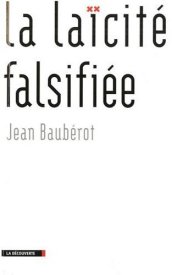
“La laïcité falsifiée”, by Jean Baubérot
Reading report by the CICNS - March 2012
In this work, the historian and sociologist Jean Baubérot illustrates the current perversion of the notion of laïcité, which he names “new laïcité”, by comparison with the “historical laïcité” put in place in 1905 at the time of the law of separation of the Churches and the State. If a certain number of his analyses are general, he nevertheless places his argument in a political perspective seeking to demonstrate that the right and the far right, having appropriated for themselves a value traditionally devolved to the left, betray it against a background of stigmatisation of Islam.
He proposes at the end of the work the conditions permitting an enlarged “Republican Front”, going “from the NPA to the centre right ill at ease in the face of the UMP’s ‘debate-debacle’, from the far left to the Gaullist and anti-xenophobic right, and to the left”, to refound laïcité: restoring a healthy debate, “unmasking as a priority powerful and permanent dominations”, “not confusing laïcité and secularisation”, “a laïcité that is accommodating and egalitarian for all families of thought”. He also takes up for himself the notion of “interior laïcité” developed by the historian Claude Nicolet: “Nicolet specifies his thought on interior laïcité: ‘In each of us there sleeps, always ready to awaken, the little “monarch”, the little “priest”, the little “important man”, the little “expert” who will claim to impose himself on others and on himself by constraint, by false reason, or quite simply by laziness and stupidity’. Nobody is safe from this internal clericalism, and the ‘secular spirit’ consists, ‘through a difficult but daily effort, [in] trying to preserve oneself from it’. Nicolet even goes so far as to conclude: ‘Laïcité, all things considered, is a spiritual exercise’.” See other extracts from the book at the end of the article.
We will nevertheless make two criticisms. The first is that at no moment are the question of the spiritual minorities and its corollary, the policy of fighting the cults, mentioned (unless one counts a non-explicit reference to the 1995 report). Let us note also that during the UMP debate in the spring of 2011 (see our synthesis on the notion of laïcité) the spiritual minorities were not judged worthy of being mentioned in the reflection, lamentable though it was; they are probably considered by the leaders of that party as outside the field of “laïcité”, deserving nothing but national opprobrium. The second criticism is that without this omission, the book’s principal thesis, consisting in presenting the right and the far right as the principal actors of the falsification of laïcité, contrasting with a more balanced vision of the French left (even if the latter can sometimes be “contaminated by the gentle monster”), would be much less convincing, because where the fight against the cults is concerned, the left appears at least as anti-secular as the right.
Jean Baubérot being one of the rare French intellectuals to have got his feet wet on the question of the “cults”, we have no doubts about his critical opinions regarding the anti-cult fight conducted in France. We easily imagine that the intellectual pirouette consisting in not mentioning it allows him to get his message across on, notably, the deleterious relationship of a certain French right and far right to laïcité, to Islam and to immigrants — a message which otherwise would be delegitimised: to call into question the treatment of the question of the “cults” has indeed this consequence in France — the country of the Enlightenment —: an immediate social and professional delegitimisation.
Nevertheless, can a political thesis — the left better than the right on the question of laïcité, and a Republican Front able to refound laïcité — be argued on the defence of a community of 6 million people (an approximate evaluation of the Muslim community) while forgetting 500,000 others (the population of the said victims of “cults” according to the MIVILUDES) who have the whole political chessboard against them? We do not think so. Far left, left, centre, right and far right are sadly united in the intellectual fiasco that the anti-cult policy represents, and therefore in the crumbling of the notion of laïcité.
It would be useful for courageous intellectuals to come together to denounce publicly the French anti-cult policy, their number, which we may hope would be substantial, and their renown making a mass delegitimisation more improbable.
Extracts
“The ‘new laïcité’, as we know, most often confuses Jacobinism and laïcité and applies the latter term to limitations of liberty and measures of control in the name of an absolute Republic (at least when it is a matter of certain French people, considered, in fact, as citizens apart).”
“The falsification of laïcité would not be a social and political success if it were solely due to the FN. The UMP’s debate, in the spring of 2011, dovetails with this lepenisation of laïcité. In 2009-2010, the calamitous ‘debate on national identity’ had proved to be a fiasco for the government. (…) A debate is then announced by the general secretary of the UMP, Jean-François Copé. It is to bear on Islam and the Republic. The turmoil, even on the right, is immediate. This debate is then rebaptised ‘Debate on laïcité’. The term is once again used as a magic word, capable of transforming a much-criticised initiative into an incontestable one.”
“For a quarter of a century, the conception of laïcité has been founded on ‘affairs’ constructed by the media. The politicians intervene, in general, only in a second phase, finding themselves constantly exposed in the face of the media. Some ‘surf’ on these affairs, exploit them; others do not dare to go against emotions and fears linked to the dominant media representation of reality.”
“The ‘new laïcité’ is first of all a tele-visual construction of laïcité: tele-visual and not tele-auditory! Here, in a few words, is how things happen: a young woman with an agreeable voice telephones you one day to announce that Mr X (a star presenter whose name is supposed to impress you) is in the middle of preparing his next programme, devoted to laïcité. If you are invited onto the set, she continues, what will you say there? Thus interrupted unexpectedly in the middle of your work, you try to answer as best you can. Three scenarios are then possible.
First case: you decline the invitation because the tone of the programme in question displeases you, or simply because you have other plans.
Second case: you would be ready to take part, but it is judged that what you have announced does not fit into the clear-cut scenario the presenter had envisaged for his programme: far too dialectical! You are not called back.
Third case: you are indeed summoned onto the set. You had been told that you ‘would have time to express yourself’. In fact, the guests are more numerous than expected and, for reasons of ‘rhythm’, the debate is constantly interrupted: ad hoc reports are broadcast here and there, parliamentarians and public figures are brought in by telephone… These little reports are, in reality, above all intended to establish the star journalist’s power. They are constructed according to the needs of the cause. The spotlight is trained on a small number of cases supposed to account for a global reality. But, in reality, one shows what one wishes. By skilful editing procedures, ‘real people’ are made to say what it has been decided to make them say, the contributions that do not fit the pre-established scenario being systematically cut. In the end, these reports resemble little scenarios more than the reality of which they claim to be the reflection.
We are indeed here in the presence of the ‘gentle monster’ as Raffaele Simone presented it: an object constructed out of whole cloth, which blurs the distinction between reality and fiction, a spectacle, a ‘scene destined to be looked at’. The multiple interactions that shape all social reality, the close relation with a context, all that has disappeared. Real-fiction has been fabricated, generally to illustrate the ‘rise of the fundamentalisms that threaten the Republic’.”
“There exist today two typical profiles of declared partisans of laïcité. The first is situated in the updating, more or less considered, of a historical secular culture. For the second, the proclaimed attachment to laïcité is in reality proportional to a hostility towards Islam and immigrants. It is this last representation of laïcité, at once reduced and hypertrophied, which, conveyed by mass culture, seems to have imposed itself in a dominant manner.
The left is ill at ease, because it itself sometimes oscillates between these two types of representation of laïcité. Globally, it remains attached to elements of the historical secular culture, but it is also in part contaminated by the mental structures of the gentle monster.
(…) In the current conjuncture, this situation must be overcome. A broad ‘Republican Front’ can oppose those who falsify laïcité, who use it as a stigmatising mask.”
“No family of thought must be official; all must benefit from a concrete egalitarian liberty. Society moreover has a cultural interest in the existence of multiple expressions which belong to a logic other than that of market values and of the dilution of meaning.”
Sources
- « La laïcité falsifiée », de Jean Baubérot (archived copy of http://www.cicns.net/Laicite_falsifiee.htm)
English translation of « La laïcité falsifiée », de Jean Baubérot (French), originally by CICNS.
This page reproduces third-party material (press agency reports and/or press articles). The rights to that material remain with their respective publishers; reproducing it here does not constitute a claim of ownership or licence.